
From foresight to action — the second phase of Future of Aid 2040
Phase 2 of Future of Aid 2040, Pathways to Transformation (P2T), moved the conversation from scenarios to solutions. Through workshops on four continents and consultations with over 500 participants, we co-created practical pathways for local, intermediary and enabling actors to become fit for the futures ahead — and translated those pathways into two new resources: a Report, and a Guide your organisation can use today.
After Phase 1 mapped four plausible futures for aid in 2040, Phase 2 asked the harder question: what now?
Pathways to Transformation was designed to translate foresight insight into something organisations can act on. Rather than prescribe a single future-proof model — which would defeat the purpose of scenario thinking — it set out to:
Co-create future-fit value propositions for three categories of actors: local, intermediary, and enabling — grounded in the four 2040 scenarios and the Causal Layered Analysis insights of Phase 1.
Build complementarity across the aid ecosystem, starting with local leadership and extending outward to intermediaries and enablers.
Develop a practical toolkit that organisations could pick up and use — not another framework to be read and shelved.
Phase 2 - the process
Phase 2 ran as a global, iterative consultation process linking online sessions with face-to-face workshops in Addis Ababa, Medan, Berlin, Jakarta, Uzhhorod, Makassar, Mexico City and Rome.
Virtual consultations introduced the four 2040 scenarios and asked participants to identify and rank the levers of transformation most relevant to their own organisations.
Local actors in Eastern Europe, Central America, South-East Asia, the Middle East and Sub-Saharan Africa analysed the scenarios, mapped value chains and fragilities, and co-designed future-fit profiles for their context.
Intermediary actors built on those local insights to define complementary roles and competencies, refining proposals through joint iteration sessions in Europe and Asia.
Local and intermediary actors reconvened to validate the emerging value propositions and stress-test complementarity between roles.
Enabling actors — donors, networks and coordination bodies — reviewed the consolidated results and co-designed the incentive mechanisms required to make transformation possible.
In total, over 500 participants shaped the work.
Future of Aid Phase 2 outputs
The Phase 2 – From analysis to action: transforming actors report uses an overarching value chain to represent the activities that are critical for the implementation of aid and proposes new archetypes of what different organisations in an effective aid system could look like.
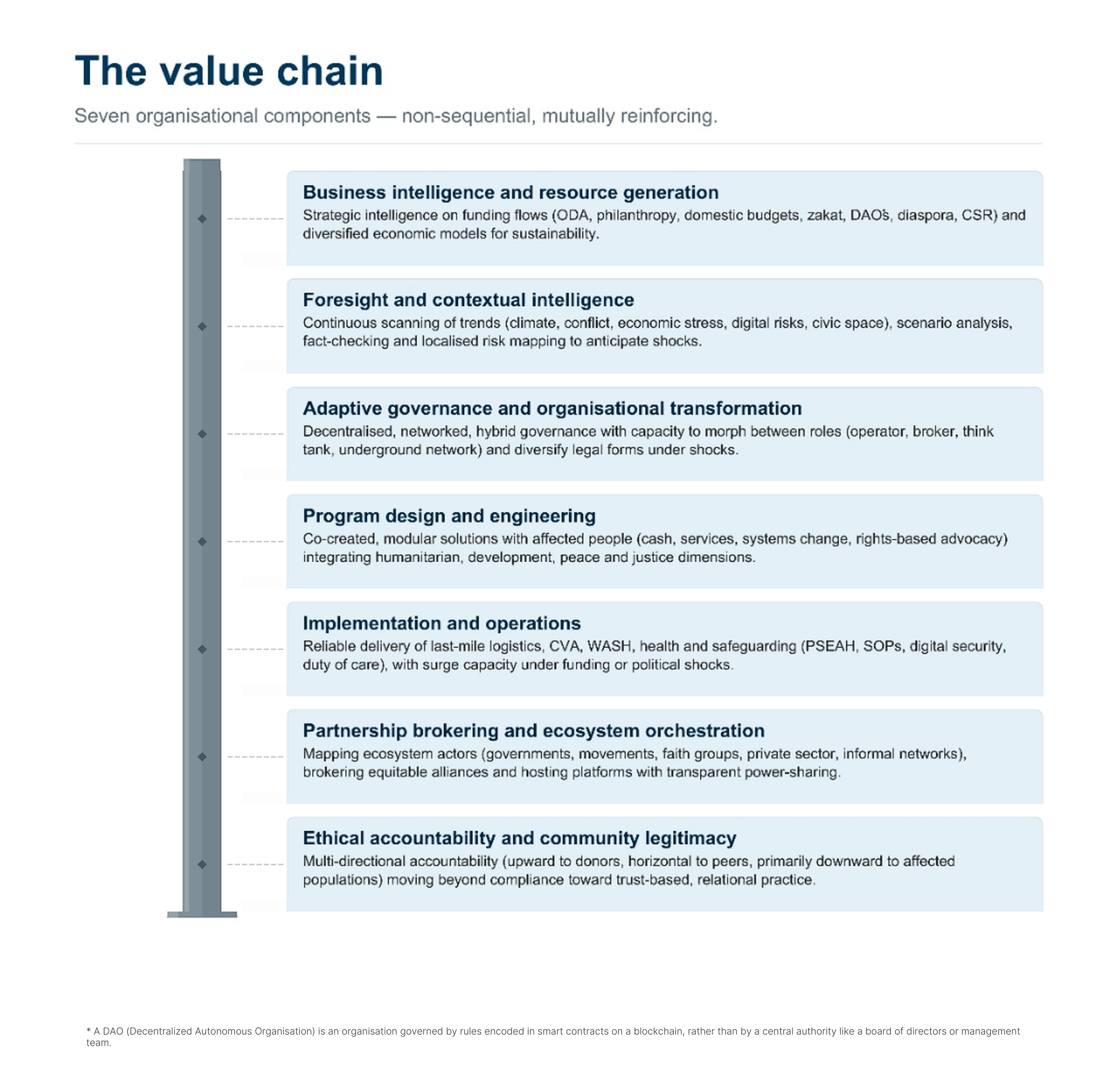
When considering how to operationalise change towards an aid system in which local leadership is the norm and responsiveness to community demands is mainstreamed, it can be a useful first step to start from a shared map of what the system actually does. A value chain is a simple and effective way to do that.
Unlike in corporate settings, we do not propose to use a value chain to find areas of competitive advantage; rather, we use this analysis to determine how different actors can collectively contribute to impact for crisis‑affected people in a coordinated and complementary way.
Organisational archetypes
-
Convenes coalitions, runs shared platforms, and builds trust and accountability across actors in its space. It focuses on coordination, pooled learning, and collective advocacy, with membership dues and funded coordination as its main support model.
-
Protects civic space and rights by anticipating shocks, documenting harm, supporting legal defence, and shaping narratives and policy. It acts as a watchdog and strategist rather than a large service provider, grounding its work in community priorities and rights-based change.
-
Provides long-term, trusted support before, during, and after crises through everyday services, mutual aid, and practical problem-solving. Its value lies in proximity, continuity, and legitimacy, supported by flexible funding, local resource mobilisation, and hybrid income sources.
-
Creates and maintains shared infrastructure such as pooled funds, learning platforms, data commons, and joint accountability systems. It enables collaboration, reduces duplication, and supports mutual learning through member-controlled governance and fees for shared services.
-
Connects finance, knowledge, and political access to locally led initiatives while minimizing compliance burdens. It acts as a lean conduit for resources, with local partners retaining oversight and decision-making over how funds are used.
The Future of Aid: Transforming Actors report endeavours to capture visions of different kinds of civil society organisations that would be effective actors across multiple future contexts. The very core of these ideas is that the future needs to be one defined by plurality, respect and collaboration; not all organisations will look the same, be governed by the same norms or speak the same language, but leveraging these differences is where greater impact can be found.
The outputs of this study are not prescriptive. They are intended to be a companion to the Pathways to Transformation (P2T) guide which organisations can use to lead their own journey of transformation.
Transformation: a deliberate process of rethinking what an organisation does, how it works, and with whom — driven by an honest look at the present and a shared vision for the future.
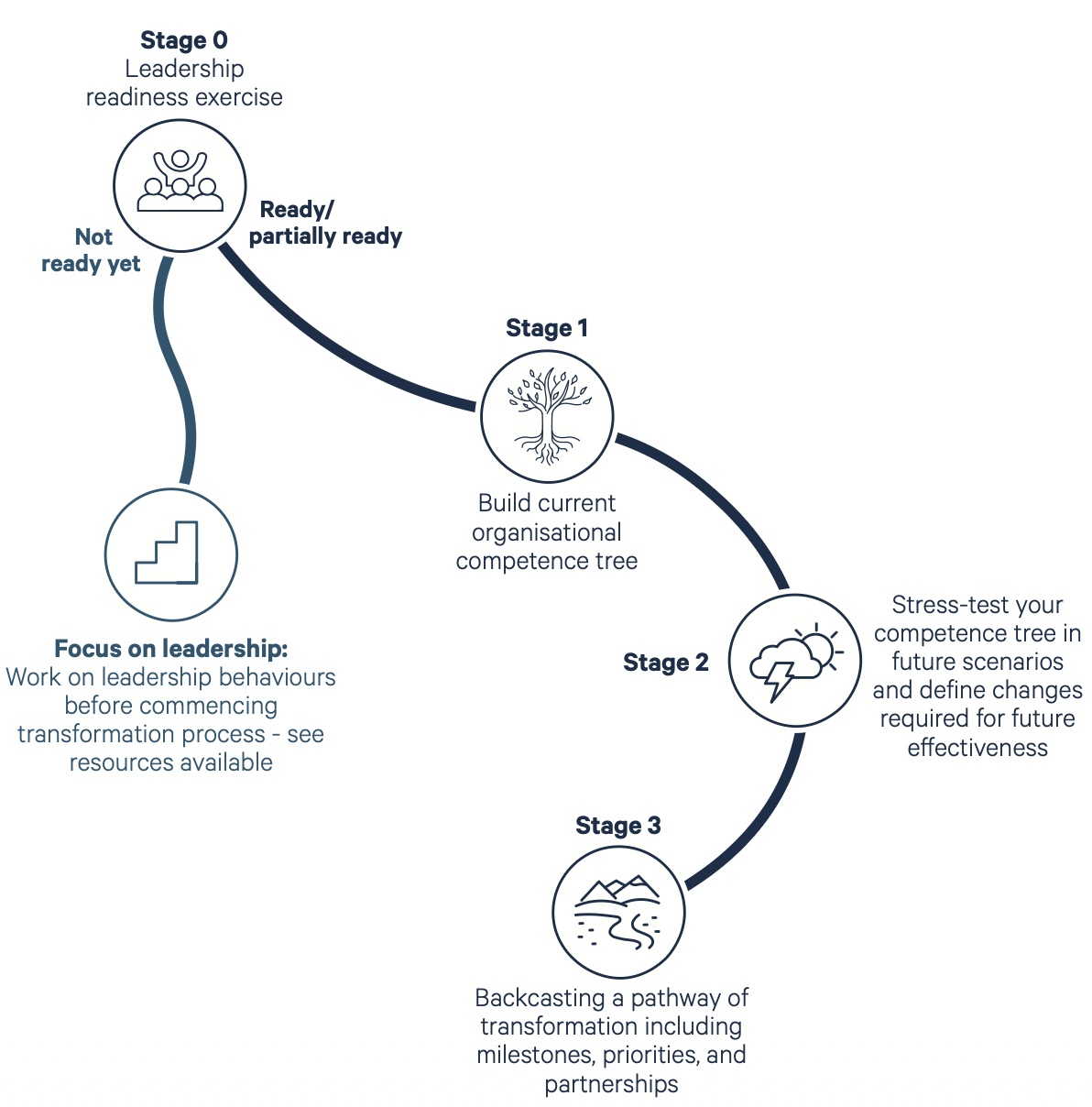
The Pathways to Transformation (P2T) guide that accompanies the Phase 2 report provides a practical companion for organisations looking to define the future for themselves. It provides detailed steps, timings and facilitation tips for assessing leadership readiness (Stage 0); drawing the organisational competence tree (Stage 1); testing it in futures (Stage 2); and backcasting a pathway of transformation (Stage 3).
Sensing Exercise — how fit is your organisation for 2040?
Start with your experience. No preparation or prior reading is needed.
In about 15 minutes, reflect on the seven components of the Fit for the Future aid value chain. Your answers build a personalised picture of where your organisation is strong, where it is under strain, and where transformation could make the greatest difference.
Your result begins with “Your organisation is X% fit for 2040.” This is a starting point based on your own answers, rather than a prediction or an external assessment.
You will receive:
A profile of all seven components, with strengths in green and areas needing attention in yellow or red.
A personalised narrative and priority areas to explore with your team.
A mini-report you can print or save as a PDF.
Use your profile to open a team conversation, then follow the P2T Guide to turn reflection into practical steps. You can also choose to share your report with IARAN’s facilitation team and request a conversation about your results.
About 15 minutes · No login required · Explore individually or with your team
Support for P2T Guide facilitators
The P2T Guide is structured so that it can be implemented by organisations themselves. To help in this endeavour, facilitators can find some additional support materials below.
Facilitator slides - A presentation organised by P2T stage, with relevant Future of Aid 2040 findings and instructions for facilitating the exercises. View the PDF for a preview, or download the editable PowerPoint to adapt the slides and add your organisation’s own material.
Leadership Readiness Platform - As additional support for Stage 0 - Leadership Readiness Exercise linked below you will find an open resource where the leadership survey is pre-loaded onto a platform that requires you to only enter the names, positions, relationship and email address of the participants and raters you would like to consult. The platform will send the relevant survey link to each participant and rater for their evaluation and, when you are ready, produce the subsequent output summary.
Feedback on the P2T Guide
We are eager to hear from organisations using the P2T Guide and capture any feedback you may have on what was useful and what can be improved. All comments will be registered and used to update and improve the Guide for future users.
Please use the form below to share any feedback on the P2T Guide with us directly!