
S1 — Aid on Many Paths
A multipolar world where regional alliances lead response, and local actors shape governance and funding models.
Future of Aid 2040
Scenarios & Crisis Typology
The Future of Aid 2040 study combined two complementary foresight traditions to explore how global and systemic forces are reshaping aid:
Causal Layered Analysis (CLA) revealing the deeper narratives, worldviews, and myths that underpin humanitarian action.
La Prospective mapping the key drivers of change and their interactions to build plausible, decision-ready scenarios.
Together, these methods reveal not only what could happen but why.
During Phase 1, a global community of aid practitioners and crisis-affected people engaged in a series of consultations to analyse the drivers transforming both the global environment and the aid system, and to identify the crisis patterns the sector must prepare for.
This participatory process culminated in a comprehensive Causal Layered Analysis and the co-design of four future scenarios, consolidated in two core publications: Unpacking the Aid System: Laying the Groundwork for Transformation and Future of Aid 2040: Scenario Report.
Futures Thinking — Exploring the aid landscape over the next 15 years, identifying key drivers and worldviews. → Watch recording, Download presentation here: EN, FR, ES
Types of Crises — Analysing potential vulnerabilities and preparedness strategies for emerging crisis patterns. → Watch recording, Download presentation here EN, FR, ES
Scenarios for 2040 — Developing possible futures and strategic responses for a resilient, adaptive aid sector. → Watch recording, Download presentation here EN, FR, ES
Through this global foresight process, 25 drivers were analysed: from geopolitical realignment, climate disruption, and digital governance to localisation, funding models, and public trust.
These were distilled into five critical drivers that underpin four alternative futures for the aid system.
Each scenario highlights how organisations can remain effective, legitimate, and locally anchored in radically different contexts.
Redistribution of global power, erosion of Western-led multilateralism, rise of regional blocs, and competition over security, technology and strategic resources.
Read driver file →Extreme weather, biodiversity loss, ecological transition, and competition over natural resources and water.
Read driver file →Refugees, IDPs, economic migration and diaspora mobilisation, shaped by conflict, climate stress, governance, demographics and changing development pathways.
Read driver file →Local leadership, devolution of decision-making, governance shifts in aid delivery, and self-determination of affected populations.
Read driver file →Donor dependency vs. diversification, rise of new funding actors, shifting priorities, transparency pressures, and changing expectations for accountability and results.
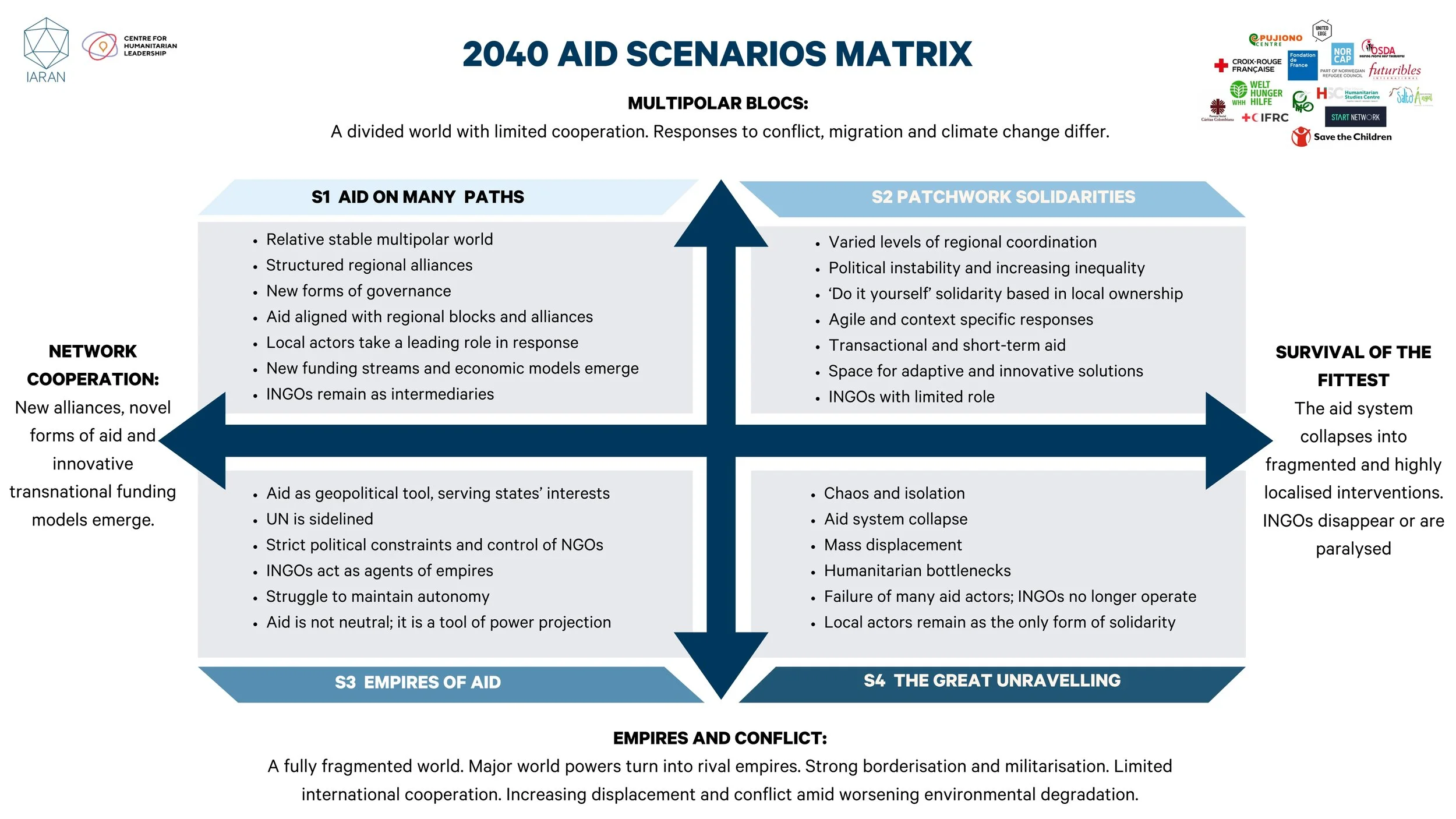
Read driver file →A multipolar world where regional alliances lead response, and local actors shape governance and funding models.
Fragmented yet adaptive solidarities emerge as instability grows; agile local networks and short-term aid fill institutional gaps.
Aid becomes a geopolitical instrument of competing powers; NGOs operate under tighter control serving rival blocs’ interests.
Systemic collapse into isolation and crisis; many aid actors vanish, leaving communities to sustain solidarity alone.
Wind-tunnel priorities across the four futures; identify the most robust bets.
Decide what to keep, adapt, drop, and what’s missing for future-fitness.
Map milestones from 2040 back to today; align capabilities and partnerships.
Invest in agency, anticipatory action, and legitimate, locally-led governance.
In humanitarian discourse, crisis is often framed as a sudden event requiring immediate response. In practice, however, most crises are not isolated shocks. They emerge from the interaction of environmental, social, political, technological, and institutional systems, and unfold over time through the accumulation of pressure, exposure, and institutional fragility.
This means that crisis cannot be understood only by looking at the triggering event. Its severity, duration, and transformative effects depend equally on the forces that destabilise a context, the resilience of affected communities, and the configuration of the aid ecosystem surrounding them. Drawing on insights from 877 contributors to Future of Aid 2040, this typology identifies three interdependent dimensions through which crisis can be analysed more systematically and more anticipatorily.
Rather than treating crisis as a fixed category, the framework invites practitioners to examine how these dimensions combine in different contexts. It is at their intersection that distinct crisis configurations emerge — helping humanitarian actors better understand not only what is happening, but how a situation may evolve and where action can still alter the trajectory.
The Future of Aid 2040 typology is built around three independent dimensions, each running along a continuum from low to high. Together, they generate eight possible configurations, seven of which correspond to named crisis types. This framework makes it possible to distinguish between crises not only by their visible symptoms, but by the deeper relationship between structural conditions, active pressures, and collective capacity.
A — Aid / Ecosystem Configuration refers to the degree of coherence, legitimacy, and responsiveness within the aid and institutional environment. At the lower end, systems are relatively coordinated, locally grounded, and able to support collective response. At the higher end, they become fragmented, politicised, externally driven, or disconnected from local realities, thereby compounding rather than containing crisis.
B — Destabilisers captures the intensity of the forces disrupting a given context. These may include armed conflict, climate shocks, economic collapse, epidemics, political repression, or other drivers of systemic stress. Destabilisers can take the form of acute events or slow-burning pressures, but in both cases they shape how quickly a crisis escalates and how widely its effects spread.
C — Community Resilience reflects the ability of people and local systems to absorb shocks, adapt, and recover. High resilience does not mean the absence of vulnerability; rather, it points to the presence of social cohesion, local leadership, trust, mutual support, and collective agency. Low resilience indicates that populations are more exposed, isolated, or excluded, with fewer capacities to withstand disruption.
Crisis typologies emerge where these three dimensions intersect. By shifting attention from isolated events to relational patterns, the triadic framework supports a more forward-looking approach to humanitarian analysis — one that helps identify where breakdown is likely, where resilience is already present, and where changes in the aid ecosystem could make intervention more effective.
The eighth configuration — where aid system dysfunction is high, destabilising pressures are low, and community resilience remains strong — is intentionally left unnamed. It represents a transitional and analytically open condition: structurally fragile, yet not fully crystallised into a recognised crisis type. Leaving it unnamed is a deliberate choice, signalling that some situations should be monitored and interpreted carefully rather than prematurely classified.
The intersection of the three dimensions produces eight possible configurations. Seven of them correspond to recognisable crisis patterns observed across humanitarian contexts; the eighth is intentionally left unnamed as a transitional and analytically open condition. Taken together, the seven typologies offer a shared vocabulary to describe how crises differ in nature, not only in intensity.
Protracted Collapse — Institutions decay over time, and crisis is sustained by exhaustion and fragmentation rather than by any single triggering event.
Erosive Crisis — Environmental and economic erosion gradually undermines livelihoods, while the withdrawal or weakening of aid structures deepens fragility.
Technocratic Fallout — Over-managed, highly proceduralised systems fail to reach affected populations, as bureaucracy and automation exclude the most vulnerable.
Weaponised Crisis — Crises are instrumentalised by political or armed actors, and civilians become trapped within dynamics of controlled violence and coercion.
Strategic Abandonment — Neglected territories sustain themselves through solidarity, self-organisation, and local leadership, despite the retreat of external support.
Persecution and Disenfranchisement — Targeted repression and systemic exclusion coexist with persistent community resistance and collective agency.
Ecosystemic Crises — Interlinked human and natural systems collapse simultaneously, producing cascading failures that overwhelm conventional response capacities.
To make these dynamics navigable, the framework is rendered as an interactive triadic cube. Each axis represents one continuum — A, B, and C — moving from low to high, and each highlighted octant corresponds to one of the seven typologies. By selecting a typology or exploring the model in three dimensions, users can better grasp how different combinations of institutional conditions, destabilising forces, and community resilience produce distinct crisis patterns, and why apparently similar situations may require different forms of anticipation, preparedness, or response.
A Aid / Ecosystem Configuration • B Destabilisers • C Community Resilience
The triadic framework described on this page has been operationalised as a free, interactive diagnostic tool: the Triadic CDT — Crisis Diagnostic Tool, available at crisis.futureofaid.org. Developed for humanitarian practitioners, analysts, and field coordinators, the tool allows users to describe a specific context (territory and operational setting), then assess each of the three dimensions by selecting qualifiers that best reflect observed conditions on the ground. As selections are made, a live 3D cube calculates the corresponding crisis typology in real time, translating the analytical model into an immediately actionable classification.
A second phase of the tool generates a contextualised analytical report based on the user's inputs. Produced via AI-assisted analysis, the report situates the identified crisis typology within the specific context described, and can be emailed directly for documentation, briefing, or planning purposes. The Triadic CDT is available in both English and French. It is designed to be used independently or as part of a team assessment process — with no registration required.
Recognising crises as systemic and co-produced challenges traditional humanitarian models. It calls for a shift from short-term response to long-term transformation: anticipating risk, preventing breakdown, and strengthening local agency.
These insights now inform Phase 2 — Pathways to Transformation, where organisations use the 2040 scenarios to stress-test, adapt, and re-design their strategies for the future.